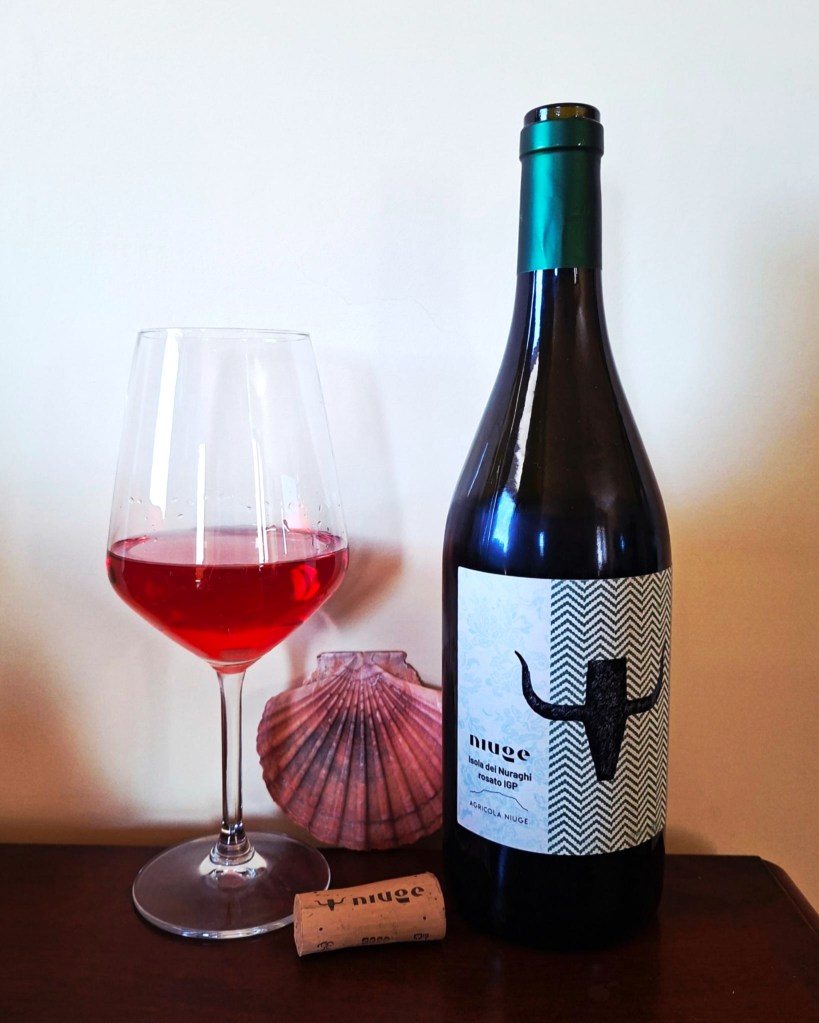
Today’s tasting note is dedicated to Niuge Rosato, the rosé wine produced by Agricola Niuge, a small estate based in Nughedu Santa Vittoria, in western Sardinia, within the historic region of Barigadu.
This is also the first tasting note on this blog dedicated to a rosé wine—a category that is gaining increasing attention worldwide, including in Sardinia, where more producers are now experimenting with different styles. As a result, both the quality and diversity of Sardinian rosés have improved significantly in recent years.
Niuge Rosato fits perfectly into this evolving landscape. It is a bold and characterful rosé, combining remarkable freshness and acidity with structure and minerality. It stands apart from the now ubiquitous Provence-style rosés, offering instead a more textured, and lighter interpretation.
This approach reflects the philosophy of Agricola Niuge. Although the estate was established only in 2017, it builds on a long family tradition. The goal is to blend tradition and innovation, both in the vineyard and in the cellar. Production remains very limited—around 6,000 bottles per year, focused on indigenous grape varieties grown at altitudes between 300 and 650 metres.
Vineyard and Winemaking
Niuge Rosato is produced primarily from Cannonau, a natural choice for rosé in Sardinia, as also seen in Garnacha-based rosados in Spain and Grenache rosés in France.
The grapes are harvested early, typically at the beginning of September, to preserve acidity and aromatic freshness. The vineyards are located between 450 and 600 metres above sea level, where significant diurnal temperature variation enhances both elegance and aromatic precision.
The vines are trained as traditional alberello (bush vines), with a density of approximately 8,000 vines per hectare. This system encourages deep root development and improves resilience to water stress.
Soils at higher altitudes are primarily decomposed granite, poor in nitrogen but rich in potassium—conditions that favour quality grape production and contribute to the wine’s distinctive minerality.
In the cellar, vinification takes place in stainless steel at controlled temperatures (around 15°C), preserving the wine’s freshness, purity, and aromatic finesse.
Tasting Profile
Appearance:
Bright medium pink, vivid and luminous.
Nose:
High aromatic intensity, with aromas of raspberry, strawberry, pomegranate, and yellow peach, alongside floral notes such as Scotch broom and rockrose. More complex layers emerge with earthy and spicy nuances (thyme, black pepper), a delicate forest floor note, and subtle yeast-derived hints (yogurt, pastry). A distinct wet stone minerality—typical of granite soils—adds further depth.
Palate:
Dry, with high acidity and 13% alcohol, delivering excellent balance. Tannins are medium and fine-grained, gently persistent and contributing to structure. The wine is medium(+) bodied, with a texture that is both fresh and slightly austere, emphasising elegance and precision.
The palate reflects the nose, with an added saline and mineral edge that enhances the wine’s definition and drinkability.
Finish:
Medium(+) finish, persistent and structured, driven by lingering acidity and subtle tannins. The aftertaste is clean, elegant, and slightly savoury, reinforcing the wine’s gastronomic profile.
Final Thoughts
Niuge Rosato is an elegant and distinctive rosé, slightly less immediate than many Cannonau- or Grenache-based rosés, but far more rewarding in terms of depth and persistence.
While the aromatic profile remains fruit-driven, the wine displays a notable level of complexity, with earthy, spicy, mineral, and saline nuances. This balance makes it suitable for moderate ageing (up to 2–3 years), which may further enhance its complexity without compromising freshness.
Its structure and versatility open up a wide range of pairing possibilities. It can be enjoyed well chilled (6–8°C) for a fresher expression, or slightly warmer (10–12°C) to better appreciate its spicy and earthy dimensions.
This is not a “simple” rosé for casual sipping—it is a serious, gastronomic wine. It pairs beautifully with Sardinian charcuterie (such as guanciale or pancetta), where its acidity cuts through fat, and also with goat cheeses, whose intensity matches the wine’s aromatic profile. For a local and elegant pairing, it works equally well with culurgiones.
A rosé that does not go unnoticed—and is not meant to.
 Sardinian Wine Stories
Leave a comment