A blog on wine should naturally focus on the fermented grape juice itself. Yet, a numbers enthusiast like me can’t resist bringing in a few statistics. Data, after all, provide context: they help us understand where Sardinia stands within Italy’s and Europe’s broader wine landscapes, what types of wines dominate, and how production is evolving over time.
As of the end of 2022, Sardinia’s total vineyard area amounted to roughly 28,000 hectares, about 4% of Italy’s total (688,000 hectares). Given that Sardinia accounts for about 8% of Italy’s total land area, this suggests that its wine production footprint is relatively modest. Comparable regions such as Piedmont and Sicily, for instance, cultivate two to four times as much vineyard surface.
Distinctive Features of Sardinian Viticulture
Several structural features help define Sardinia’s viticulture. Around 40% of the island’s vineyards are still planted as bush vines, a traditional form that thrives in Sardinia’s dry, windy climate and remains ideal for certain varieties like Cannonau. Moreover, about 53% of Sardinian vines are over 30 years old, a figure that underscores the presence of many old vineyards contributing to concentrated, characterful wines.
Wine Production Volumes and Quality Focus
When we look at production figures, Sardinia’s relatively small scale becomes even clearer. In 2022, the island produced approximately 533,000 hectolitres, just 1.1% of Italy’s total wine output (49.8 million hectolitres). While small in absolute terms, this lower yield indicates a focus on quality rather than quantity.
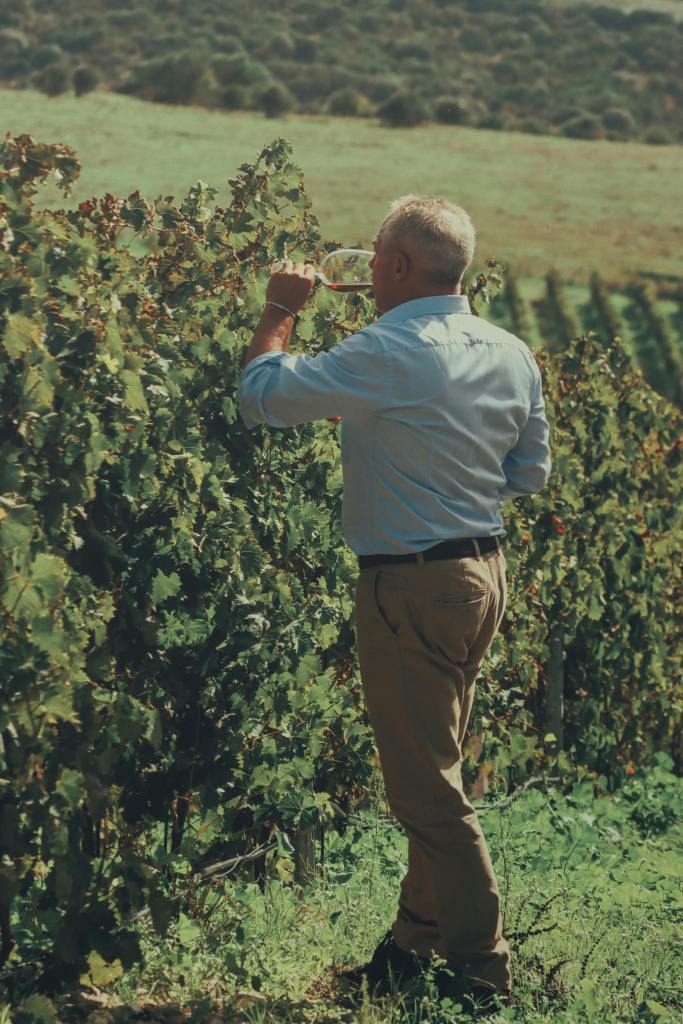
Photo Credits: Efrem Efre – Pexels
Indeed, about 95% of Sardinian wine is produced under PDO (Protected Designation of Origin, DOC in Italian) or PGI (Protected Geographical Indication, IGT in Italian) classifications—one of the highest shares in Italy. Nearly three-quarters of total production falls under the more stringent PDO category, a strong signal of Sardinia’s commitment to quality winemaking. (It should be noted, however, that the wide territorial coverage of some PDOs can blur this picture slightly—an issue not unique to Sardinia.)
Sardinia in the International Context
While Sardinia may appear small within Italy, it stands quite respectably on the international stage. Italy itself is one of the world’s top three wine producers, alongside France and Spain. In global terms, Sardinia’s wine production is comparable in volume to that of Bulgaria, Croatia, or Czechia—medium-sized European producers. Looking only at PDO wines, Sardinia’s output (391,000 hl) even surpasses that of Greece (159,000 hl). Within the French context, its production would be similar in scale to that of Beaujolais or Roussillon.
All this makes Sardinia a small-to-medium-sized wine power, notable for its consistent emphasis on quality and authenticity.
Evolution Over Time
Historically, Sardinia’s vineyard area expanded steadily until the early 1980s, reaching a peak of over 70,000 hectares in 1984. Thereafter, it declined sharply—by about 56% between 1984 and 2001—largely due to EU programs encouraging vine removal to address Europe’s wine surplus. Since 2001, the vineyard area has stabilised, though with replanting concentrated in more suitable areas aimed at producing higher-quality wines under PGI and PDO designations.
Wine production has followed a similar trajectory, with a mild decline in recent years, reflecting lower yields and, in part, the impact of climate-related challenges on harvests. While this trend limits total volumes, it reinforces the island’s evolution toward higher-quality, terroir-driven wines.
In a future post, I’ll explore in more detail the production data by grape variety and sub-region, shedding further light on how Sardinia’s unique terroirs express themselves in the glass.
 Sardinian Wine Stories
Leave a reply to Sardinian Wine in Numbers: A Closer Look at the Main Varieties – Sardinian Wine Stories Cancel reply