In a previous post, I provided an overview of Sardinia’s wine production in terms of volumes and quality, offering some broader context within Italy and Europe. However, there is much more to say about Sardinia’s wines from a quantitative perspective — and as a numbers geek, I can’t resist delving deeper into the data.
In this post, I explore which grape varieties are most widely cultivated, which wines dominate production, and how these are distributed across the island’s diverse wine regions. Unless otherwise indicated, all figures refer to end-2022 data, as reported by LAORE Sardegna, the regional agency for agricultural development. LAORE plays a crucial role in supporting Sardinian viticulture and provides an invaluable source of data and insight into the region’s wine industry.
Grape Varieties: Diversity and Dominance
More than 40 different grape varieties are currently cultivated in Sardinia. Many are native and found only on the island (e.g. Vernaccia di Oristano, Nieddera, Semidano). Others are traditional — not originally Sardinian but grown here for centuries — such as Cannonau, Carignano, and Cagnulari. Finally, there are several international or broadly Italian varieties (e.g. Cabernet Sauvignon, Chardonnay, Sangiovese, Nebbiolo).
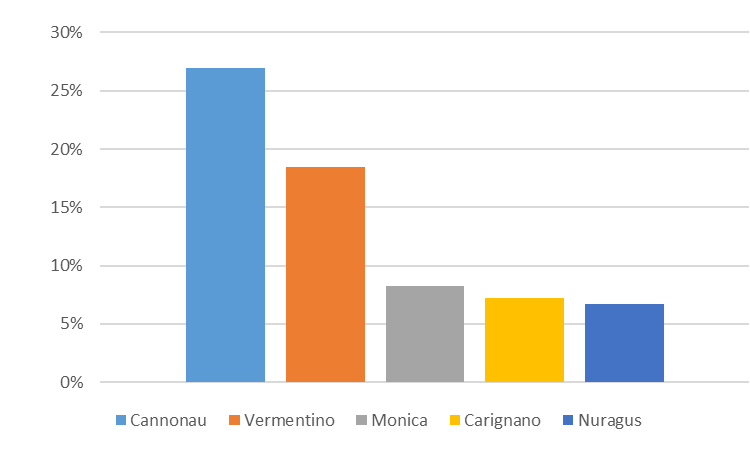
Despite this diversity, just a handful of varieties dominate production. The five leading grapes account for around two-thirds of Sardinia’s total vineyard area. Cannonau, a black variety, alone represents 27% of the island’s surface under vine, while Vermentino, a white variety, follows closely at 18.4%. Together, these two varieties — the flagbearers of Sardinia’s red and white wines — cover nearly 45% of all plantings.
Behind them, Monica, Carignano, and Nuragus each represent between 6% and 8%, underscoring their continued importance in Sardinia’s viticultural identity.
Geographical Distribution: Regional Strongholds
The distribution of these varieties across Sardinia reflects the island’s complex geography and terroirs.
- Cannonau is cultivated throughout the island, though nearly two-thirds of the total vineyard area is concentrated in the province of Nuoro, the heartland of Cannonau production.
- Vermentino shows a similar pattern, with over two-thirds of plantings located in Sassari province, home to the prestigious Vermentino di Gallura DOCG.
- Monica (black) and Nuragus (white) — two traditional workhorse varieties now enjoying a renaissance thanks to modern winemaking — are largely concentrated in the Cagliari province.
- Carignano is also primarily grown in the south, particularly in the Sulcis subzone, its historical home.
For lesser-produced grapes, the concentration is even more pronounced. The Oristano province dominates the cultivation of Vernaccia di Oristano, Semidano, and Nieddera; Sassari leads with Cagnulari (genetically related or identical to Spain’s Graciano), Torbato, and Arvesiniadu; while Cagliari remains the stronghold for Nasco and Barbera Sarda.
Evolution Over Time: Growth and Decline
The evolution of Sardinia’s grape varieties between 1990 and 2022 tells a fascinating story. While the total surface under vine has declined significantly — largely due to EU vine pull-out schemes and global shifts in consumption — the picture varies sharply by variety.
The standout performer is Vermentino, whose vineyard area has more than doubled over the period. This reflects both the rising quality and the growing international appeal of Vermentino wines, which align with global preferences for aromatic, elegant, and fresh white wines.
In contrast, Nuragus, once among the island’s most widely planted varieties, saw its vineyard area drop by almost 80% between 1990 and 2022. Fortunately, the trend has stabilized recently, with renewed interest from quality-focused producers breathing new life into this traditional variety.
Among black grapes, Cannonau’s decline has been more moderate — around one-third — compared to Pascale and Bovale, both of which lost roughly two-thirds of their vineyard area. This difference may reflect the greater challenge of producing high-quality wines from these varieties, an issue that modern winemaking technology is increasingly overcoming. Meanwhile, Carignano has shown remarkable resilience, maintaining much of its planted area.
Looking Ahead
In a forthcoming post, I will examine production data at the sub-regional level, shedding further light on how Sardinia’s diverse terroirs express themselves in the glass. I’ll also dedicate space to explore each variety’s unique characteristics — and what makes Sardinia’s viticultural mosaic so distinctive.
 Sardinian Wine Stories
Leave a comment