Vermentino is Sardinia’s leading white grape variety — and one of the most talked-about Mediterranean grapes today. Plantings keep rising, not only on the island but across the globe, and its name is increasingly replacing long-standing synonyms like Rolle in Provence.
Versatile, expressive, and unmistakably Mediterranean, Vermentino offers an impressive range of styles depending on terroir, ripeness, and winemaking approach. Let’s dive into its story.
History & Origins
Vermentino’s historical footprint stretches across the Western Mediterranean — Sardinia, Liguria (as Pigato), Piedmont (as Favorita), Corsica, and Provence (Rolle). This shared presence points to centuries of maritime exchange, particularly in regions influenced by Genoese trade.
Its true origin remains uncertain. Some scholars once suggested a Spanish birth, but the grape is not found today in Spain, making this hypothesis unlikely. A more plausible scenario is that Genoese merchants, active across Corsica and Sardinia, helped spread an already-existing variety throughout the region.
But was it originally Sardinian? Corsican? Ligurian? Or did it arrive from farther east? DNA profiling has yet to reveal conclusive parentage. For now, Vermentino’s beginnings remain one of the Mediterranean’s gentle mysteries.
Cultivation
Vermentino is early-budding and mid-ripening, and — crucially — thrives in hot, windy, sun-drenched environments with poor, well-exposed soils. Sardinia’s coastal vineyards, shaped by marine breezes and intense summer light, are its natural home.
One of its great strengths is the ability to retain acidity even in warm, dry years, enabling fresh, elegant wines despite harsh conditions. Alberello training is often used in the driest zones, while Guyot and other systems appear elsewhere.
The variety shows notable resilience to drought, and while heat, wind, and sun can shift its aromatic profile, overall quality remains stable. This adaptability — so deeply Mediterranean — helps explain Vermentino’s rising success in other warm regions worldwide.
Grape & Wine Characteristics
Generalising about Vermentino is difficult. Its expression varies dramatically depending on ripeness level, vineyard site, and winemaking technique. In this sense, it shares the versatility of Chardonnay and Sauvignon Blanc.
At its freshest, Vermentino offers delicate notes of blossoms, green apple, grapefruit, sage, and fresh almond — the latter a hallmark of the variety. At fuller ripeness, it moves toward ripe apple, musk, underbrush, melon, pineapple, and almond paste.
Many estates harvest in stages to capture multiple aromatic layers in the final blend.
Minerality — a core signature
Minerality is a constant theme in high-quality Vermentino, though its origin remains debated. The “flinty–saline–stony–chalky” spectrum appears across the island:
- Granite soils of Gallura are associated with sharper, flintier expressions.
- Vineyards near the coast often show more saline nuances.
- Some researchers link Vermentino’s minerality to reductive winemaking, which protects delicate aromas from oxidation.
Winemaking
Producers traditionally favour stainless steel and short skin contact to preserve the grape’s subtle aromatics. But experimentation has grown: amphorae, concrete, longer macerations, sparkling wines, and occasional oak are now more common, giving rise to deeper, more textural interpretations.
Production and Global Context
Vermentino is today Sardinia’s most planted white grape, accounting for around 5,000 hectares (19% of the island’s vineyards). Its rise is remarkable: while Sardinia’s total vineyard area nearly halved from 1990 to 2022, Vermentino plantings almost doubled. Once overshadowed by Nuragus, it is now the island’s undisputed white ambassador.
Two-thirds of production comes from the northern province of Sassari (and especially around Alghero and in Gallura). Plantings have increased in Tuscany too, though Sardinia still produces ten times more Vermentino than Tuscany. In France, production is roughly one-fifth of Sardinia’s, with 80% concentrated in Corsica.
The variety has also reached Australia, California, and other warm-climate regions, where growers value its resilience and freshness.
PDOs and Key Sub-Zones
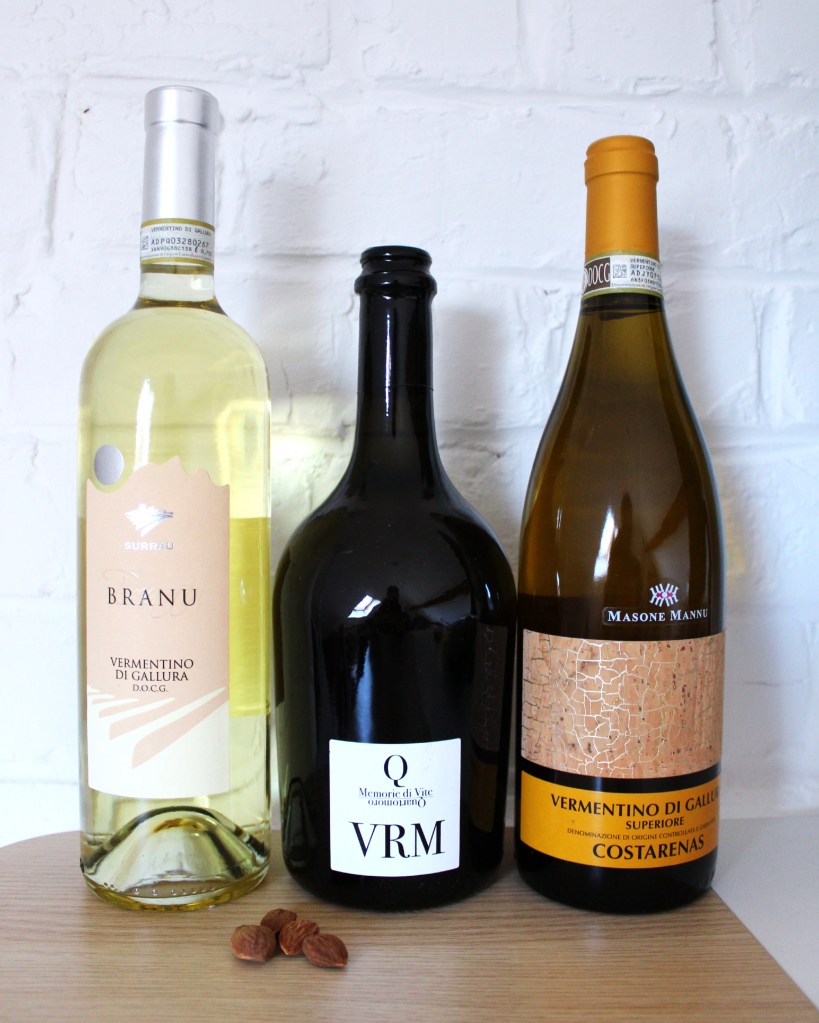
Vermentino di Gallura DOCG
Sardinia’s only DOCG lies in the island’s northeast corner, a land of poor granite soils, strong winds, and pristine light. Yields are restricted to 63 hL/ha, ensuring concentration and quality.
Gallura’s Vermentino is typically:
- high in acidity,
- crisp, elegant, and linear,
- showing notes of green apple, white flowers, almond, and helichrysum, the aromatic Mediterranean plant emblematic of the region.
Vermentino di Sardegna DOC
This island-wide denomination allows very high yields (up to 112 hL/ha), which — as with Cannonau — risks diluting the identity of the best terroirs. Many top producers voluntarily work at much lower yields to express their specific sites.
Important Sub-Zones (outside Gallura)
Based on the work of Ian d’Agata
- Usini (Northwest) – herbal, slightly vegetal expressions
- Alghero (Northwest) – fuller, more perfumed styles
- Cabras (Centre-West) – opulent, lower-acidity wines
- Serdiana (Centre-South) – nuances of capers, thyme, rosemary
- Cagliari (South) – calcareous soils giving distinctive saline notes
Conclusion
Vermentino is a grape that embodies Sardinia’s sun, wind, and sea — yet remains wonderfully adaptable, capable of delivering wines that are delicate, saline, floral, textured, or richly Mediterranean. Its growing popularity is no surprise: Vermentino offers freshness in warm climates, identity in diverse soils, and a captivating versatility that speaks directly to today’s wine lovers. Whether in a crisp Gallura bottling or a fuller expression from Alghero or Cabras, Vermentino continues to strengthen its role as Sardinia’s white ambassador to the world.
 Sardinian Wine Stories
Leave a comment