Vernaccia di Oristano is one of Sardinia’s most distinctive and historic wines, yet it remains largely undiscovered by the broader wine world. This extraordinary wine, made from the grape of the same name, native to the Oristano province, is deeply rooted in the island’s winemaking tradition. It is particularly renowned for its oxidative aging process, which gives it a flavour profile reminiscent of fine Sherries or Vin Jaune from the Jura. The wine gained official recognition with the DOC (Denominazione di Origine Controllata, the Italian Protected Denomination of Origin) status in 1971, solidifying its place in Italy’s prestigious winemaking heritage.
An Ancient Grape with a Unique Character
The origins of Vernaccia di Oristano trace back thousands of years, with records suggesting that the grape was cultivated in Sardinia as early as the Nuragic era. The grape Vernaccia di Oristano was first mentioned in 1327 in the book Breve di Villa di Chiesa (a law book from Iglesias, a town in southwestern Sardinia). Recent ampelographic and DNA research have shown that Vernaccia di Oristano is distinct from other grapes with the same name (e.g., Vernaccia di San Gimignano) and also unrelated to grapes with similar names (e.g., Garnacha). The Vernaccia grape has small, round berries with thin, yellow-gold skin.
While some theories suggest this variety was introduced to Sardinia by the Phoenicians, concrete evidence to support this claim has never emerged. On the contrary, the Nuragic civilization appears to have cultivated grape varieties related to Vernaccia, as archaeological evidence from the Nuraghe Sa Osa — close to the current area of cultivation — has shown.
A Terroir Unlike Any Other
Vernaccia is almost exclusively cultivated in the lower valley of the Tirso River, close to Oristano (on the central west coast of Sardinia). The area under vine has gradually decreased through the years, shrinking from over 1,500 hectares in the 1970s to about 580 hectares in 2000 and to about 350 hectares in 2022. This decrease is a testament to the shift from quantity to quality in wine production (and consumption) during the last decades, but also of the transformation of Vernaccia into a niche, almost luxury wine.
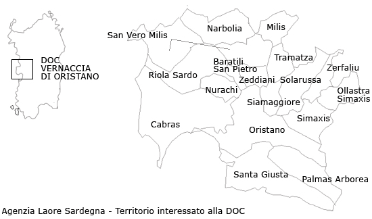
Oristano’s terroir plays a fundamental role in shaping the identity of Vernaccia di Oristano. The combination of sandy, limestone-rich soils, Mediterranean breezes, and a warm, arid climate creates the perfect conditions for cultivating Vernaccia grapes with high natural acidity and concentrated flavours. These environmental factors contribute to the wine’s longevity and remarkable ability to evolve in the bottle.
According to Ian D’Agata’s Native Wine Grapes of Italy, two types of soils have traditionally been particularly rewarded for Vernaccia’s cultivation. The Gregori are sandy soils, dry and with very limited fertility. The Bennaxi are loamy, alluvial soils and are slightly more fertile.
The Maestrale, a strong north-westerly wind (also known as Mistral in France), plays a key role in keeping the vineyards dry and disease-free, allowing for healthy grapes that can sustain long aging periods.
Winemaking and Aging Under Flor: A Rare Mediterranean Treasure
The harvest normally takes place at the beginning of October, which, by Sardinian standards, is quite late ripening. Currently, the majority of grapes are harvested from old vines (more than 30 years old), which add complexity and depth to the wines made from these grapes.
Vernaccia di Oristano is vinified using traditional Sardinian techniques, with fermentation often taking place in old wooden barrels. What makes Vernaccia di Oristano truly stand out is its maturation under a layer of flor yeast. This technique, known as biological aging, is also seen in Fino Sherry and Vin Jaune. It imparts distinctive and complex hay, saline, and acetaldehyde characteristics, making it a wine of great depth and intrigue. As the amount and type of flor can vary from year to year, this also adds an exciting vintage variation aspect to single-vintage wines.
After the biological aging, an oxidative aging phase follows. The wine is aged in small, partially filled chestnut or oak barrels, allowing slow oxidation and the development of rich, layered flavours over years—sometimes even decades—that complement the wine’s bouquet with nutty and dried fruit aromas.
Some of the wines are aged in a solera system (very much like Sherry), where barrels filled with older wine are topped with younger wine when some of the wine in the barrel is removed for bottling. However, today, many great examples are also single-vintage wines. DOC wines can be made as fortified or unfortified, dry or sweet. However, today, the best examples of Vernaccia di Oristano are dry and unfortified. Nonetheless, some examples of the wine, which undergo extended aging, can see their alcohol level grow from the 15% common in younger wines to almost 20%.
Tasting Profile, Similarities, and Differences with Other Wines
While Vernaccia di Oristano shares some stylistic traits with Sherry and Vin Jaune, it is very much its own wine. Unlike Sherry, it is normally not fortified, relying instead on its natural alcohol content (often exceeding 15% abv even in young wines) to sustain its aging process. Furthermore, while almost all Sherry wines come from a solera system, the majority of Vernaccia wines are now single-vintage ones. Compared to Sherry, Vernaccia could be considered similar to an aged Fino or an Amontillado. Compared to Vin Jaune, Vernaccia di Oristano presents a distinctly oxidative character, with more honeyed, almond, and dried citrus notes, and a slightly softer structure.
Vernaccia can thus develop the typical aromas of biologically aged wines (saline and balsamic notes, hay, acetaldehyde), but in a much more nuanced way than in a Fino Sherry. Then, through gentle oxidation, it adds notes of fresh bitter almond, toasted almond, hazelnut, dried apricot, roasted orange, and sweet spices.
Notable Producers Keeping Tradition Alive
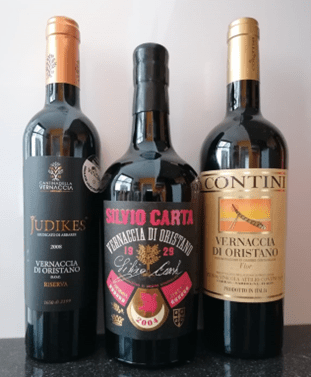
Despite its long history, Vernaccia di Oristano is a niche wine, championed by dedicated producers who work to preserve its unique identity. Among them, some notable names are:
• Contini, whose Antico Gregori wine, made with a solera incorporating wines about a century old, is probably the greatest expression of Vernaccia di Oristano.
• Silvio Carta, whose deep and complex wines regularly figure among the very best in Italian and international wine competitions.
• Cantina Sociale della Vernaccia, a cooperative winery, has been instrumental in maintaining the tradition of Vernaccia di Oristano.
• Fratelli Serra, known for crafting expressive and long-lived Vernaccia di Oristano wines.
A Wine Worth Discovering
For those seeking something truly distinctive, Vernaccia di Oristano offers an unforgettable tasting experience. Its layered complexity, history, and rarity make it a must-try for any adventurous wine lover.
If you haven’t yet explored Vernaccia di Oristano, now is the time to discover one of Sardinia’s most fascinating vinous treasures.
 Sardinian Wine Stories
Leave a reply to Tasting note – Juighissa 2013 – Cantina del Rimedio – Vernaccia di Oristano Superiore – Sardinian Wines Cancel reply