Introduction
Carignano is the third most-planted black grape variety in Sardinia and the fourth most planted variety overall, after Cannonau, Monica, and Vermentino. With approximately 2,000 hectares under vine, Carignano accounts for about 7% of Sardinia’s total vineyard area.
Despite these relatively modest figures, Carignano-based wines—whose production is overwhelmingly concentrated in the Sulcis region in the south-west of the island—are among the most distinctive and promising expressions of Sardinian viticulture. This is reflected in the steady increase in plantings over the last fifteen years, driven by a renewed focus on quality and terroir.
Sardinian Carignano is none other than Carignan in France and Mazuelo (also known as Cariñena) in Spain. Alongside wines from Catalonia—especially Priorat—Sardinia, and in particular Sulcis, stands out as one of the world’s most compelling regions for this variety. Carignano thrives in hot, dry climates and low-fertility soils, conditions that find an almost ideal match in south-west Sardinia.
Let us explore this jewel in greater depth.
History & Origins
According to the majority of researchers and wine historians, Carignano most likely originated in north-eastern Spain, in the region of Aragón. The variety appears to be closely linked to the town of Cariñena, from which it likely takes its name—Carignan in French and Carignano in Italian. As Cariñena is also a Denominación de Origen, the grape is now more commonly referred to in Spain as Mazuelo. In Catalonia, where the name Cariñena was historically widespread, the synonym Samsó is now frequently used.
There is clear evidence that Carignano was introduced to south-west France, although the precise timing of its arrival in Sardinia is less well documented. The most widely accepted hypothesis is that the variety was brought to the island during the period of Spanish rule (1323–1720). Several Sardinian synonyms appear to support this theory; one of the most telling is Axina de Spagna, literally “grape from Spain” in the Sardinian language.
Some authors have instead suggested that Carignano may have been introduced by the Phoenicians as early as the ninth century BC, pointing to the fact that Phoenician settlements were particularly concentrated in the Sulcis area, which remains the heartland of the variety today. While intriguing, this hypothesis has yet to be corroborated by robust archaeological or genetic evidence.
Notably, no colour mutations of Carignano have been identified in Sardinia, whereas they do exist in both Spain and France. According to the Russian botanist Nikolai Vavilov, the region displaying the greatest genetic diversity of a variety is often its place of origin—an argument that further strengthens the case for a Spanish birthplace.
Viticultural Characteristics
Carignano is a late-budding and very late-ripening variety with excellent drought resistance. It therefore requires a warm climate and a long growing season to reach full phenolic ripeness. Naturally high-yielding—with potential yields exceeding 200 hL/ha—Carignano was historically prized for quantity rather than quality. This made it a workhorse grape, widely planted not only in Sardinia, but also in Languedoc-Roussillon in southern France and, during the colonial period, in Algeria.
At such yields, wines were typically diluted, with low flavour intensity, yet marked by high acidity and high tannins. Large-scale vine-pull schemes within the EU led to a dramatic reduction in plantings in France, where Carignano was often replaced by other varieties. In Sardinia, however, the decline was far more limited.
For the production of fine wines, yield control is essential. One natural limiting factor is vine age: vines over 50 years old naturally produce lower yields, while simultaneously increasing flavour concentration. The warm, dry Mediterranean climate of Sardinia—further moderated by strong, desiccating sea breezes—is particularly well suited to achieving full ripeness, as Carignano performs poorly in humid conditions.
Given its natural vigour, Carignano is ideally suited to bush-vine training (alberello), which helps regulate growth and further reduce yields. The variety is also best adapted to hand harvesting, as the bunches are firmly attached to the vine.
Carignano and Bovale Grande: One and the Same Grape?
Several scholars have suggested that Carignano and Bovale Grande—another Sardinian black grape variety traditionally grown around Terralba in central-west Sardinia—may in fact be the same variety. This hypothesis is supported by DNA profiling and by one of Bovale Grande’s historical synonyms, Bovale di Spagna, again pointing to a Spanish origin.
However, close observation in the vineyard reveals that, while the two varieties share similar ampelographic traits, they are not identical. Most Sardinian viticulturalists consider them closely related, but distinct, and the wines they produce show perceptible differences that argue against complete identity.
For the time being, it is therefore more appropriate to regard Carignano and Bovale Grande as separate but closely related varieties—possibly different biotypes or offshoots of a common parent. As current DNA analyses are based on a limited number of markers, future, more detailed studies may yet refine our understanding.
Denominations, Soils & Terroirs
Although small plantings of Carignano exist elsewhere on the island, the vast majority—around 90% of Sardinia’s total surface under vine—is concentrated in the Sulcis region, which is also home to the only Carignano-based PDO: Carignano del Sulcis DOC. The main communes involved include Giba, Sant’Anna Arresi, San Giovanni Suergiu, Santadi, Masainas, Carbonia, Sant’Antioco, and Calasetta.
The Superiore sub-category of the DOC requires bush-vine training, already common practice in the area. Limited irrigation is permitted during vegetative growth, but not after véraison. Maximum yields are set at 77 hL/ha for the basic DOC—levels that can result in wines of modest concentration—while the Superiore category restricts yields to 52.5 hL/ha. Both Superiore and Riserva wines require a minimum of two years of ageing.
The terroir of Sulcis plays a decisive role. Shallow, sandy soils of very low fertility help naturally restrain vigour and encourage balanced ripening. Many vineyards are planted with very old, ungrafted vines, some over a century old, made possible by the sandy soils’ resistance to phylloxera. Abundant sunshine—averaging around seven hours per day—combined with the hot Scirocco winds from Africa, further shapes the wines’ character.
As a result, quality-focused producers routinely work at yields well below the DOC limits, producing wines that are a true ode to typicity.
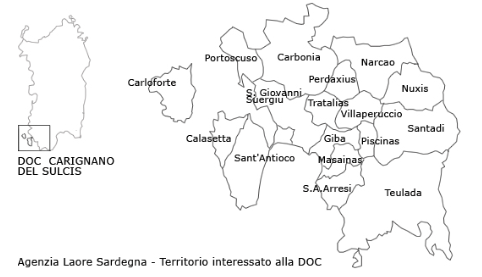
Map from Sardegna Agricoltura
Wine Style & Aromas
Carignano naturally brings high acidity, deep colour, and firm tannins to its wines, making careful winemaking essential to achieve balance.
Several stylistic approaches are possible. Wines from younger, grafted vines, often planted on soils with higher clay content, may be vinified using carbonic maceration—a technique long employed in France and increasingly adopted in Sardinia. These wines typically show softer tannins, bright acidity, and straightforward black-fruit aromas.
Another option is blending, occasionally with international varieties. This approach was famously championed by the late Giacomo Tachis, the oenologist behind Sassicaia and the Carignano-based Barrua from Sulcis. Such wines often display greater depth and complexity, with fruit complemented by spice, earthy notes, and savoury nuances. Carignano also responds well to oak ageing, commonly for 12–18 months, which helps to round and integrate its youthful tannins.
Wines produced from very old vines occupy a category of their own. Naturally low yields deliver extraordinary concentration, layered complexity, and a distinctive creamy, velvety texture. This textural quality—unique to Sulcis and largely unmatched elsewhere—seamlessly integrates Carignano’s acidity and tannins, resulting in wines of remarkable balance and elegance.
Conclusion
While Carignano is neither the most planted nor the most widespread black grape variety in Sardinia, it is undoubtedly one of the island’s most compelling.
The variety is not exclusive to Sardinia, yet Carignano-based wines from Sulcis stand among the finest expressions worldwide. Alongside great examples from Priorat, southern France, and Chile, Sardinian Carignano distinguishes itself through its elegance, balance, and textural depth—qualities that reflect a rare alignment of old vines, extreme terroir, and informed viticulture.
Well adapted to hot, dry conditions, Carignano is also particularly well positioned to face the challenges of climate change. Its full potential, especially in Sardinia, is still being uncovered—and the most exciting chapters may well be yet to come.d singling out a few would do injustice to many. I’ll dive into individual examples in future tasting notes—one sip at a time. 🍷
 Sardinian Wine Stories
Leave a reply to Tasting Note: Dominariu 2023 – Melis – Terralba DOC – Sardinian Wine Stories Cancel reply