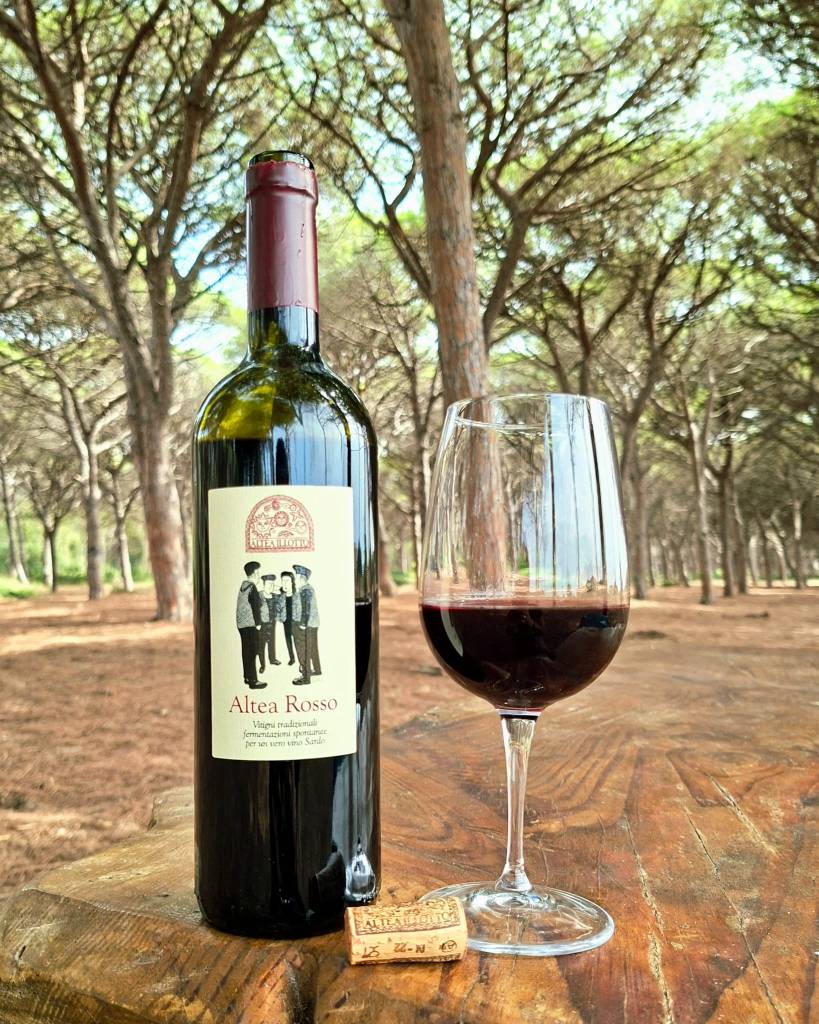
This tasting is dedicated to Altea Rosso, a red blend produced by Altea Illotto, a small family-run winery based in Serdiana, in southern Sardinia. The estate is widely recognised as one of the pioneers of organic viticulture on the island, having adopted organic farming practices as early as 1993. Its philosophy is centred on respecting the environment and allowing the grapes to express their natural character, with minimal intervention in the cellar.
Altea Rosso brings together four traditional Sardinian grape varieties — Cannonau, Carignano, Monica and Barbera Sarda — in a blend that captures the character of the Serdiana area. The result is a wine that combines the richness and structure of its grapes with a winemaking approach that puts the fruit and its origins centre stage.
This is, after all, the philosophy of Altea Illotto. Founded by agronomists Maurizio Altea and Adele Illotto, the estate has around five hectares of vineyards in the countryside surrounding Serdiana. Its vineyards have been cultivated organically since 1993, while the winery has embraced natural winemaking practices since 1999. Synthetic chemical products are excluded from vineyard management, fermentations rely on indigenous yeasts, and only very low quantities of sulphur dioxide are used in the cellar. Traditional vineyard practices and a strong sense of respect for the land complete the picture. More than simply a winery, Altea Illotto represents a consistent philosophy: making wines that reflect their territory while intervening as little as possible in the process.
Vineyard and Winemaking
Altea Rosso is made from a blend of Cannonau, Carignano, Monica and Barbera Sarda, sourced from vineyards in the Sibiola area of Serdiana. The vines grow on predominantly clay- and limestone-rich soils, under a Mediterranean climate characterised by mild winters and hot summers. Yields are kept low, at around 40 quintals per hectare.
Harvest takes place during the first week of September. In the cellar, fermentation starts spontaneously with indigenous yeasts, followed by eight days of maceration on the skins, allowing for the extraction of colour, structure and tannins.
The wine then matures for 14 months in small stainless-steel vats on the lees, a period that helps preserve the freshness of the fruit while allowing the wine to develop greater complexity. This is followed by at least two months of bottle ageing before release. Production is limited to approximately 3,000 bottles per vintage, making Altea Rosso a relatively small-scale expression of the Sibiola territory.
Tasting Profile
- Colour: Bright, deep ruby red, with delicate garnet reflections.
- Aroma: The nose is intense and complex, initially dominated by red and black fruit. Redcurrant, raspberry and red plum mingle with blackcurrant, blackberry, black cherry and black plum. As the wine opens, further layers emerge: delicate hints of tomato leaf, eucalyptus and Mediterranean herbs such as thyme, rosemary and mastic, followed by liquorice, black pepper and balsamic notes. There are also more mature aromas of cooked fruit, prune and liqueur-soaked cherry, alongside hints of wet leaves, forest floor, hazelnut and chocolate. A remarkably broad aromatic profile, with ripe fruit at its core but plenty of savoury and herbal complexity.
- Palate: Dry, with high acidity and high, firm tannins that give the wine considerable structure and grip. The tannins have a slightly stalky character, contributing to the wine’s distinctive, somewhat nervy profile. Despite this firmness, the texture is surprisingly round and chewy, supported by a full body and a substantial concentration of flavour. The high alcohol content (14.5%) adds warmth and power, but is balanced by the wine’s vibrant acidity and tannic structure. Flavour intensity is high, with black fruit and balsamic notes particularly prominent. The Carignano seems to make an important contribution to the wine’s firm tannic backbone, while the other varieties help bring fruit, roundness and balance.
- Finish: Long and persistent. The initial astringency gradually gives way to more pronounced balsamic and spicy notes, accompanied by a delicate mineral impression. The tannins remain present right through to the end, providing a firm and lingering conclusion.
Final Thoughts
Altea Rosso is a fine example of what can be achieved through a philosophy that moves away from conventional, interventionist winemaking. Produced from organically cultivated grapes and with a minimal-intervention approach in the cellar, it brings together four traditional Sardinian varieties in a wine that is both distinctive and remarkably accomplished.
Its combination of elegance, roundness, intensity, concentration, power and freshness is particularly impressive. The aromatic profile moves well beyond straightforward red and black fruit, revealing successive layers of balsamic, herbal and spicy notes. The fruit is ripe and generous, yet never feels excessive or heavy. There is a lovely tension between the wine’s richness and its freshness, which gives it both depth and energy.
In terms of style, I found some similarities with the more structured and elegant wines of the Southern Rhône, although Altea Rosso retains a very distinct Sardinian identity. It is a wine with plenty of personality, and one that certainly stands out within the Sibiola appellation.
The combination of high alcohol, vibrant acidity and firm tannins should provide a solid foundation for bottle ageing, potentially for 10 years or more. At the same time, the freshness and expressiveness of its fruit make it enjoyable even at a relatively young age. Having tasted the 2021 vintage when it was already around five years old, however, I would recommend allowing it some time in bottle to soften its rather assertive tannic structure.
I would also suggest serving it slightly cooler than the usual room temperature, at around 16°C, particularly in its youth. With further bottle age, the temperature can be allowed to rise towards 18°C. A little aeration would certainly help too: around one hour in a decanter should give the wine enough time to open up and reveal more of its aromatic complexity.
Despite its structure and concentration, Altea Rosso is also a versatile companion at the table. Its ripe fruit and generous texture would work particularly well with Sardinian charcuterie, such as cured ham and other savoury cured meats, as well as with mature Pecorino cheeses. The wine’s acidity would provide a welcome counterpoint to the saltiness and richness of these foods.
It would also be an excellent match for pasta dishes with tomato-based sauces, such as malloreddus alla campidanese or, looking beyond Sardinia, bucatini all’amatriciana. The acidity of the tomato sauce should complement the wine’s freshness, while its structure and concentration would stand up well to the richness of the accompanying ingredients.
And yet, Altea Rosso is also a wine that can be thoroughly enjoyed on its own. Its aromatic complexity, evolving layers and distinctive structure make it an engaging glass to spend time with, even without food.
A beautifully expressive red from Serdiana, and a convincing reminder that minimal intervention does not mean sacrificing depth, structure or ambition.


Leave a Reply