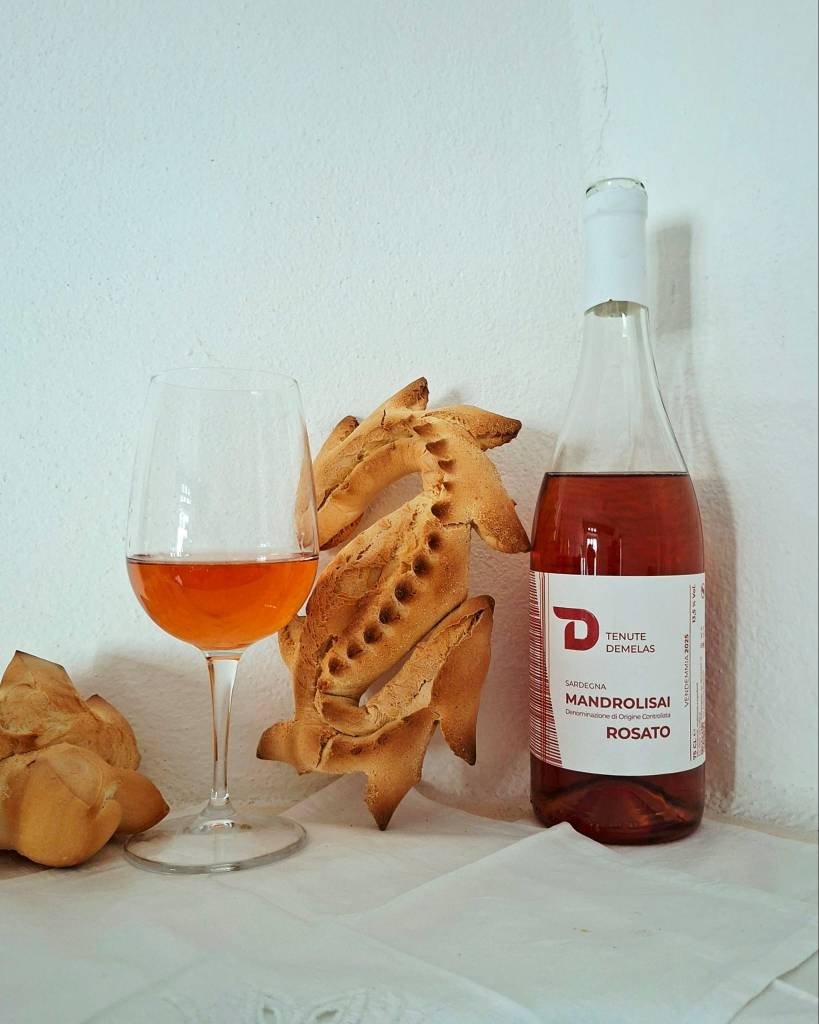
Even though summer has ended and we are gently entering autumn, temperatures can still be pleasantly mild — and nothing feels more appropriate than a refreshing and crunchy rosé. Today’s tasting note is therefore dedicated to Mandrolisai Rosato 2025, produced by Tenute Demelas, a young, family-rooted estate based in Samugheo, in the heart of the Mandrolisai.
Mandrolisai Rosato is yet another wine that shows the potential of Sardinia to produce distinctive and characterful rosé wines. It is an approachable and fruit-forward rosé, but one that retains enough structure and freshness to express something of the territory from which it comes.
Rosé production has been evolving considerably in Sardinia in recent years, with producers exploring different interpretations of the style. Mandrolisai Rosato fits into this broader movement while remaining firmly rooted in the traditional grape varieties of its appellation.
Tenute Demelas was founded in Samugheo in 2020, with the aim of recovering the family’s vineyards and developing wine production in the Mandrolisai area. The estate currently works approximately two hectares of vineyards, situated on the hills around Samugheo at altitudes ranging from approximately 200 to 400 metres.
The vineyards are planted with the traditional Mandrolisai varieties Bovale Sardo, Cannonau and Monica, locally known as Muristellu in the case of Bovale Sardo. The vineyards are cultivated according to organic principles, with a traditional and environmentally respectful approach. The estate’s first bottling was its Mandrolisai DOC Rosso, while the Mandrolisai Rosato represents a more recent addition to the range.
Vineyard and Winemaking
Mandrolisai Rosato is made from the classic Mandrolisai blend of Bovale Sardo, Cannonau and Monica. This combination is particularly interesting when interpreted as a rosé: varieties traditionally associated with a structured red wine are instead used to produce a wine focused on freshness, fruit and drinkability.
The vineyards are located on predominantly granite-derived soils, with a smaller contribution from schistose soils. The area is characterised by significant day-night temperature variations, while the vineyards occupy the hilly landscape around Samugheo.
The vines are trained using traditional bush-vine (alberello) systems in the older vineyards, while younger vineyards are trained using cordon spur-pruned systems.
At present, the grapes are processed and the wine is produced in the cellar of another winery in Samugheo, as Tenute Demelas does not yet have its own winery. The construction of a dedicated cellar is one of the estate’s next major objectives.
The wine is vinified in stainless-steel tanks. Rather than undergoing the prolonged skin contact associated with the extraction of colour and tannins in a red Mandrolisai, the grapes receive a short and gentle contact with the skins, allowing the wine to acquire its delicate rosé colour while preserving the freshness of its floral and red-fruit aromas. The wine remains in bottle for at least six months before release, while yields are deliberately kept low, at around 35 quintals per hectare.
Tasting Profile
- Appearance: Bright, pale pink-orange, with a delicate luminosity.
- Nose: The wine has medium aromatic intensity, with a varied and expressive aromatic profile. Floral notes of rose and blossom mingle with red-fruit aromas of redcurrant, raspberry, strawberry and pomegranate. There are also hints of orange and peach, alongside a subtler blackcurrant note. With time in the glass, more savoury nuances emerge, including forest floor, hazelnut, bread dough, candy and Mediterranean scrub.
- Palate: The wine is dry, with medium acidity and 13.5% alcohol. The alcohol contributes to a soft and rounded mouthfeel, while the freshness of the fruit keeps the wine lively and easy to drink. The tannins are low and fine-grained, but remain delicately persistent, giving the wine more structure than one might initially expect from a rosé. The wine is medium(+) bodied, with a rounded texture and a pleasant sense of concentration. A mineral and savoury impression emerges on the palate, adding an additional layer of complexity and elegance. The fruit flavours are accompanied by a delicate bitter note reminiscent of red fruit skins, which contributes to the wine’s freshness and vibrancy.
- Finish: The finish is medium in length, with a lingering sensation of fine tannin complemented by the wine’s mineral and savoury character. The combination of gentle astringency, freshness and rounded texture gives the finish more persistence than might be expected from such an easy-drinking style.
Final Thoughts
Mandrolisai Rosato by Tenute Demelas is a fruit-forward and approachable rosé, but with a distinctly Sardinian personality. Its point of difference lies partly in the fact that the style remains less widespread in Sardinia than in some of the better-known rosé-producing regions of France and Spain.
What makes it particularly interesting, however, is the use of the traditional Mandrolisai blend of Bovale Sardo, Cannonau and Monica. These varieties are much more commonly encountered in structured red wines, so seeing them interpreted as a rosé offers an intriguing perspective on their versatility.
And the result is convincing. The wine is round and flavourful, yet retains freshness and elegance. Red berries and delicate floral aromas dominate the profile, while the more savoury, herbal and mineral nuances add complexity without making the wine feel heavy.
As a typical rosé, this is not a wine I would buy primarily for long-term cellaring. It is a wine designed to be enjoyed young, fresh and full of fruit. Nevertheless, its acidity, modest tannic structure and overall concentration suggest that it should remain enjoyable for a few years. I would personally drink it within the first two to three years, rather than deliberately waiting five years, because I suspect that its most attractive qualities are precisely its freshness and youthful fruit.
This is the quintessential apéritif wine: serve it fresh, around 8–10°C, and enjoy it on a sunny terrace, whether in Paris, Shanghai or Olbia. I would avoid serving it as cold as a very light white wine, however, because a slightly higher temperature will allow its floral, fruity and savoury nuances to emerge more clearly.
But don’t mistake easy drinking for lack of gastronomic potential. This wine has enough structure, acidity and concentration to work very well with food.
I would particularly enjoy it with poultry, such as roast chicken, or, for a more adventurous pairing, chicken yakitori, where the wine’s acidity and delicate tannins could provide an interesting counterpoint to the sweetness and umami of the soy-based glaze.
And then there is the perhaps most unexpected pairing: grilled or fried chistorra. The wine’s acidity would cut through the sausage’s richness and oiliness, refreshing the palate after every bite, while its red-fruit character would create an appealing contrast with the savoury, spicy flavours of the chistorra.
Ultimately, Mandrolisai Rosato 2025 is a reminder that the traditional grapes of Sardinia do not have to be confined to traditional styles. Bovale Sardo, Cannonau and Monica can produce a rosé that is fresh, generous and easy to enjoy, while still carrying a subtle imprint of the landscape around Samugheo. A Mandrolisai for the terrace, perhaps — but one that still has something to say about where it comes from.


Leave a comment