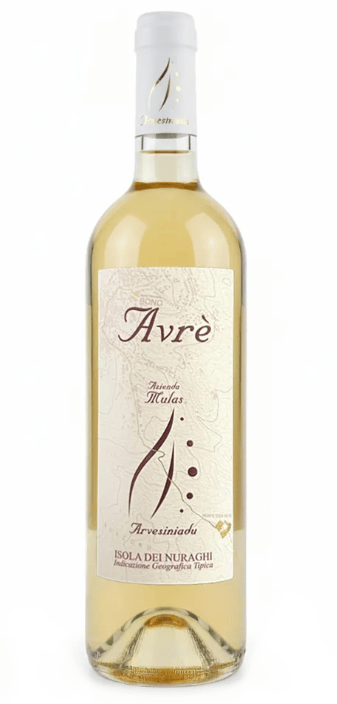
Today’s tasting note is dedicated to Avrè, a varietal Arvesiniadu (also known elsewhere in Sardinia as Arvisionadu) off-dry white wine produced by Azienda Mulas, a small estate from the village of Bono, in northern Sardinia.
Avrè represents a particularly important wine for Sardinia because its underlying grape variety, Arvesiniadu, was once at serious risk of disappearing. At the end of the 1980s, a passionate grower from Azienda Mulas in Bono embarked on a mission to recover the variety, an effort that proved fundamental to preserving an important part of Sardinia’s viticultural biodiversity.
The variety was traditionally cultivated on the clay soils of the Nurcoro area, trained using the traditional alberello system and supported by sa raiga, a structure used to support its vigorous but delicate shoots. This system has subsequently evolved towards modern low-trained spalliera.
In this sense, Avrè is one of the archetypal expressions of Arvesiniadu, and arguably one of the best starting points for discovering this fascinating variety. It represents a genetic unicum, with no known close relationship to other grape varieties. I will explore the variety itself in greater detail in a future post.
Azienda Mulas, active since 1992, has made the recovery and promotion of Arvesiniadu one of its defining missions. Based in Bono, in the Goceano region of north-central Sardinia, the estate cultivates approximately two hectares of vineyards in the Nurcoro area, following organic viticulture principles and harvesting by hand. Thanks in large part to this pioneering work, an increasing number of Sardinian producers are now experimenting with Arvesiniadu/Arvisionadu. Modern viticultural and winemaking techniques are increasingly demonstrating the potential of this rare native variety.
Vineyard and Winemaking
Avrè is produced from Arvesiniadu grapes grown on the clay soils of Nurcoro, near Bono in the Goceano region. Here, the variety finds a distinctive environment in which its characteristics can fully emerge.
The vines are cultivated on medium-textured clay soils typical of the area. Traditionally trained as alberello, Arvesiniadu required a particular support known as sa raiga, necessary to sustain its shoots, which, despite their vigorous annual growth, are remarkably thin and delicate.
Azienda Mulas cultivates approximately 2 hectares of vineyard, with controlled yields of around 60 quintals per hectare. Annual production of Avrè is limited to approximately 2,000 bottles, making it a particularly small-production wine. The grapes are hand harvested and then pressed and fermented in stainless-steel tanks at controlled temperatures, with the aim of preserving the wine’s freshness and delicate fruit and floral aromas.
Tasting Profile
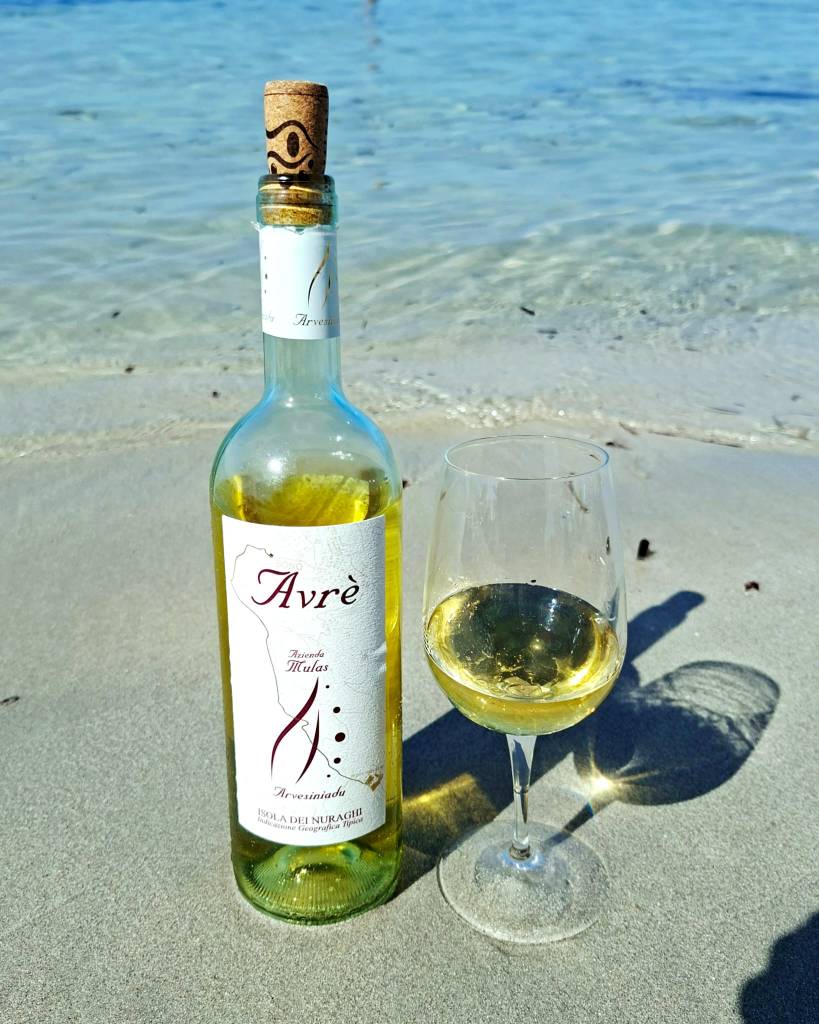
- Appearance: Bright medium lemon, almost light gold.
- Nose: The wine has medium(+) aromatic intensity, with a complex and intriguing bouquet. Floral aromas of jasmine, rose and rose water are complemented by ripe apple, ripe grapefruit, musk, green almond and almond paste. Further layers emerge with fresh hazelnut, pastry, cream and a delicate note of candied ginger. The combination of floral, fruity, nutty and pastry aromas makes the nose particularly distinctive.
- Palate: The wine is off-dry. The residual sugar is clearly perceptible, but its relatively moderate level, combined with medium(+) acidity, keeps the wine fresh and highly drinkable. The wine is full-bodied, and its soft, round texture gives it a certain richness and sophistication. The aromas detected on the nose are also evident on the palate, with a more pronounced emphasis on almond, both in its slightly bitter form and as almond paste. These notes add further complexity and help balance the sweetness. Its 13.5% alcohol contributes additional substance and structure, reflecting the maturity of the grapes at harvest without overwhelming the wine’s delicate balance.
- Finish: The finish brings a touch of bitterness and very delicate astringency. Rather than detracting from the wine, these elements balance the residual sugar and leave a refined, lingering impression.
Final Thoughts
Avrè is a very peculiar wine. Not only is it one of the pioneering wines produced from Arvesiniadu, helping to bring a variety once at risk of extinction back to the attention of wine lovers, but it is also made in an off-dry style that is relatively uncommon in contemporary wine.
While the residual sugar might initially suggest that Avrè belongs firmly in the category of dessert wines, the wine is actually much more versatile than that. The refined balance between residual sugar, medium(+) acidity and delicate bitterness makes it a very pleasant wine to enjoy on its own.
What Azienda Mulas has achieved in preserving and promoting this grape variety is, in my view, a genuine contribution to Sardinian wine—and to the wider world of wine. The variety’s potential is still being explored, and I suspect that we will see increasingly interesting interpretations of Arvesiniadu in the years to come.
The freshness of Avrè also makes it surprisingly versatile at the table. As an off-dry wine, an obvious direction would be dessert, but I would not necessarily choose a particularly rich or heavy dessert. Its elegant floral and fruit profile would work better with something lighter, such as a fruit salad, rather than tiramisù.
Another particularly Sardinian possibility would be gueffus, the traditional almond-based pastries whose delicate aromatic profile would complement the wine beautifully. My favourite pairing, however, would probably be blue cheese, particularly a salty and assertive example. The residual sugar of Avrè would provide a wonderful counterbalance to the saltiness and intensity of the cheese.
Try it with Blue Stilton, or with the Sardinian blue cheese Muffolone by Dedoni.
I would recommend serving Avrè at around 8–10 °C. Colder temperatures could restrain some of its delicate floral and aromatic nuances, while a slightly warmer serving temperature allows the wine’s complexity to emerge more fully.
Avrè can certainly be enjoyed young, but I also see potential for around five years of bottle ageing, during which its aromatic profile could become even more complex. I would expect the almond and nutty notes to gain prominence over time, adding another layer of interest.
With slightly higher acidity, I would have recommended an even longer ageing period. Nevertheless, for such a rare grape variety, its potential is already remarkable—and Avrè offers a fascinating glimpse of what Arvesiniadu might become as more producers rediscover and experiment with it.


Leave a Reply