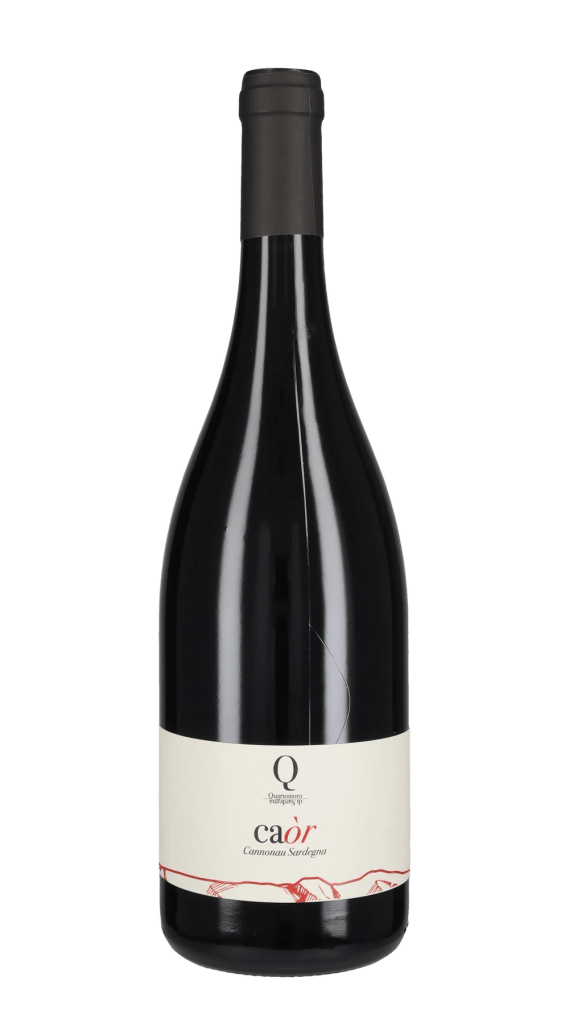
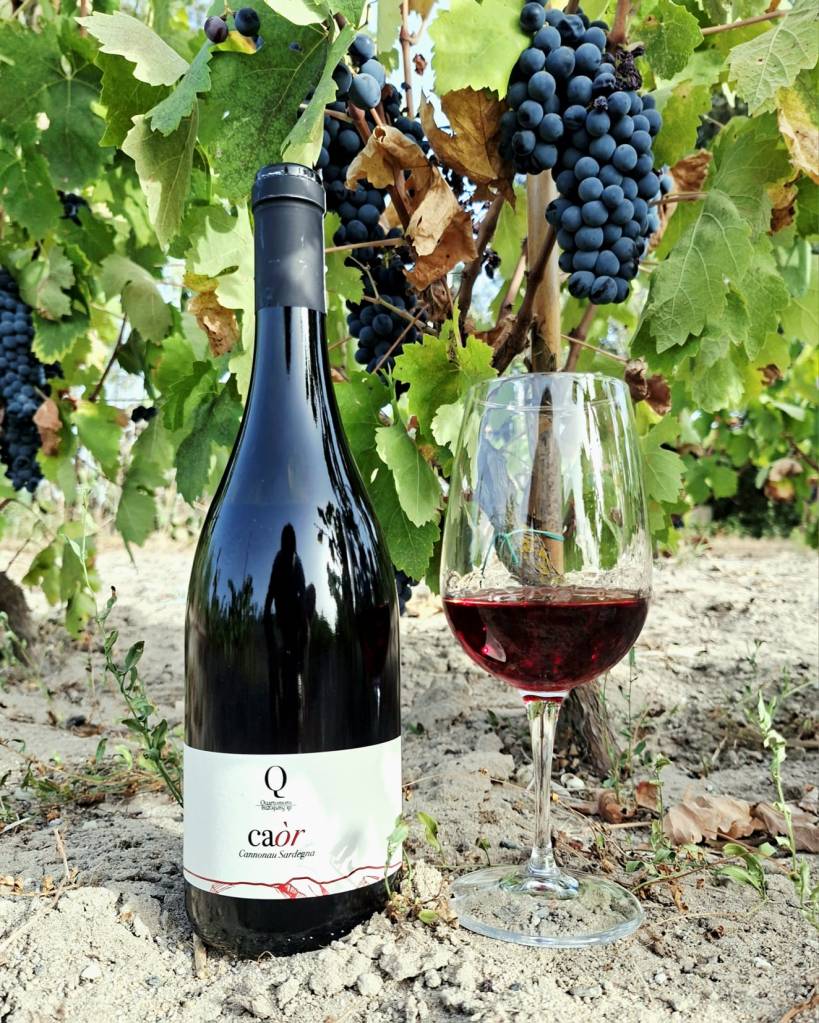
Today’s tasting note is dedicated to Caòr, a varietal red wine made from Cannonau grapes by Quartomoro, based in Marrubiu, in western Sardinia, close to the extinct volcano of Monte Arci.
Quartomoro is one of the most interesting wineries in Sardinia. The estate is run by Pietro Cella, one of Sardinia’s most accomplished oenologists, whose work places a strong emphasis on the island’s cultural and ampelographic heritage.
Quartomoro di Sardegna is an innovative, artisanal, family-run winery that was originally conceived as a “didactic winery” and experimental research laboratory. It has since evolved into a producer of high-quality Sardinian wines that celebrate the island’s extraordinary viticultural biodiversity. The winery follows a minimal-intervention philosophy in both the vineyard and cellar, while sourcing grapes from several historic areas of Sardinia, including the Oristanese, Arborea-Terralbese, Gallura and Sulcis. This allows Quartomoro to explore the distinctive expressions of different local terroirs and microclimates. Overall, the estate works with around 15 hectares of vineyards. Quartomoro focuses primarily on traditional and native Sardinian grape varieties. Caòr belongs to the Orrìu line, which focuses on fresh, vibrant wines that place particular emphasis on varietal purity.
Caòr is made from 100% Cannonau — Sardinia’s own name for Grenache — but it offers an interpretation of the variety that is quite different from the traditional Sardinian style.
For me, the peculiarity of this wine comes mainly from two elements.
First, the grapes are grown in the volcanic soils of Monte Arci, an area particularly rich in obsidian, basalt and other volcanic materials. This gives the terroir a very different character from that of Montiferru, where iron-rich volcanic soils are a defining feature.
Second, Caòr belongs to a style of Cannonau that reminds me strongly of the increasingly popular Garnachas from Sierra de Gredos, around Madrid: light-bodied, elegant, fresh and nervy, with an emphasis on crunchy red fruit, spices and minerality rather than power and ripeness.
This makes Caòr quite different from many Cannonau wines produced according to the more traditional Sardinian interpretation of the variety.
Vineyard and Winemaking
Caòr comes from young vineyards trained on a low spalliera system using Guyot pruning in the countryside around Marrubiu, a few kilometres south of Oristano. Here, the Campidano plain gradually rises towards the slopes of Monte Arci, an ancient extinct volcano whose most famous legacy is obsidian, the volcanic glass that played an important role in the prehistoric communities of the area.
The soils are clayey and sandy, formed from the weathering of volcanic material. According to Quartomoro, this combination contributes richness, minerality, freshness and elegance to the wines produced here.
Yields remain moderate, at below 80 quintals per hectare, while the grapes are harvested at full maturity. Cannonau is a relatively late-ripening variety, so harvesting generally takes place around the first ten days of October.
After harvesting, the grapes are quickly transported to the nearby winery, where they undergo destemming and crushing, followed by inoculation with selected yeasts. The must undergoes around seven days of maceration, with regular cap wetting, alongside alcoholic fermentation in stainless-steel tanks at temperatures below 30°C. After alcoholic fermentation, Caòr is matured for a further four months in stainless steel, under reductive conditions, allowing the wine to stabilise while developing additional structure without introducing oak influence.
Tasting Profile
- Appearance: Bright pale-to-medium ruby, with a distinct garnet rim. The colour is relatively light for a Cannonau/Grenache, immediately suggesting that this is not going to be a typical full-bodied expression of the variety.
- Nose: The nose has medium(+) aromatic intensity and is quite distinctive. There are delicate aromas of not-quite-ripe wild strawberry, redcurrant and red cherry, alongside rose and geranium. The fruit is complemented by a combination of white pepper, graphite, flint and dried Mediterranean herbs, particularly thyme and rosemary. The graphite note is particularly striking and persistent, giving the wine a pronounced mineral character. Behind it, I also find forest floor, eucalyptus and liquorice, followed by a very delicate suggestion of game. Overall, the aromatic profile is much more floral, spicy, mineral and crunchy than what I would normally expect from Cannonau.
- Palate: The wine is dry, with medium(+) acidity and medium(-), fine-grained tannins. The tannins are so delicate that they almost make this feel like a white wine disguised as a red. At the same time, its pronounced minerality provides a certain chewiness and prevents the wine from feeling too light or insubstantial. At 13.5%, the alcohol is moderate and perfectly suited to the wine’s medium body. The flavour intensity is medium(+), with the aromatic profile carrying strongly onto the palate. The combination of freshness, delicate tannins, crunchy red fruit, spices and minerality makes Caòr an unusually elegant and easy-drinking Cannonau.
- Finish: The finish is medium and clean, with a pleasant touch of astringency emerging right at the end. This combines with a gentle bitter note from the red fruit and reinforces the overall freshness of the wine.
Final Thoughts
Caòr is a little jewel: a fresh, nervy and almost rock-and-roll expression of Cannonau that contrasts sharply with many other wines made from the same variety in Sardinia.
For me, it is a fascinating demonstration of both the versatility of Cannonau and the creativity of Pietro Cella. The grape is capable of producing much lighter, fresher and more elegant wines than its reputation might suggest, and Caòr is a particularly convincing example.
If I had to choose a red wine to drink during the summer, Caòr would be high on my list. It is the kind of red that can work beautifully as an aperitif, especially when served chilled. Stylistically, it could compete comfortably with some of the elegant Garnachas from Sierra de Gredos, but also reminds me of the fresh, mineral character found in Cabernet Franc from Saint-Nicolas-de-Bourgueil. In fact, I find it more elegant and complex than many examples of the latter.
It could even make an interesting alternative to certain Pinot Noirs — and, remember, not all Pinot Noir comes from Burgundy! The comparison is not meant to suggest that Caòr tastes like Pinot Noir. Rather, its combination of flowers, crunchy red fruit, spice, freshness and light structure places it in a similar stylistic territory. In some respects, its aromatic profile feels closer to Pinot Noir than to the more powerful expressions of Grenache/Cannonau, highlighting just how far this wine departs from the usual interpretation of the variety.
In general, I would serve Caòr at no more than 13°C. During the summer, I actually enjoy it even cooler, at around 10°C. At that temperature, it can almost feel as refreshing as a white wine, while retaining the very different aromatic and structural profile of a red.
Caòr is undoubtedly a wine to enjoy young, when its freshness and vibrancy are at their best. That said, I would not be surprised to see it develop additional complexity over the next few years. I would personally aim for around five years of ageing at most, allowing some of its primary aromas to evolve into more tertiary notes while preserving the wine’s characteristic freshness.
In terms of food pairing, Caòr is elegant enough to be enjoyed on its own, but I think it would be particularly successful with a cheese and charcuterie platter. I would be curious to try it with two very different Alpine-style Italian and French cheeses, such as Comté and Castelmagno.
Its Pinot-like character also makes it an intriguing companion for umami-rich dishes, particularly mushrooms. Think grilled Portobello mushrooms or tagliatelle ai funghi porcini. Caòr is therefore a reminder that Cannonau is far more versatile than its traditional image might suggest. From the volcanic soils of Monte Arci, Quartomoro has produced a wine that is light, fresh, spicy and distinctly Sardinian — but also capable of speaking the language of some of Europe’s most elegant cool-climate reds.


Leave a Reply