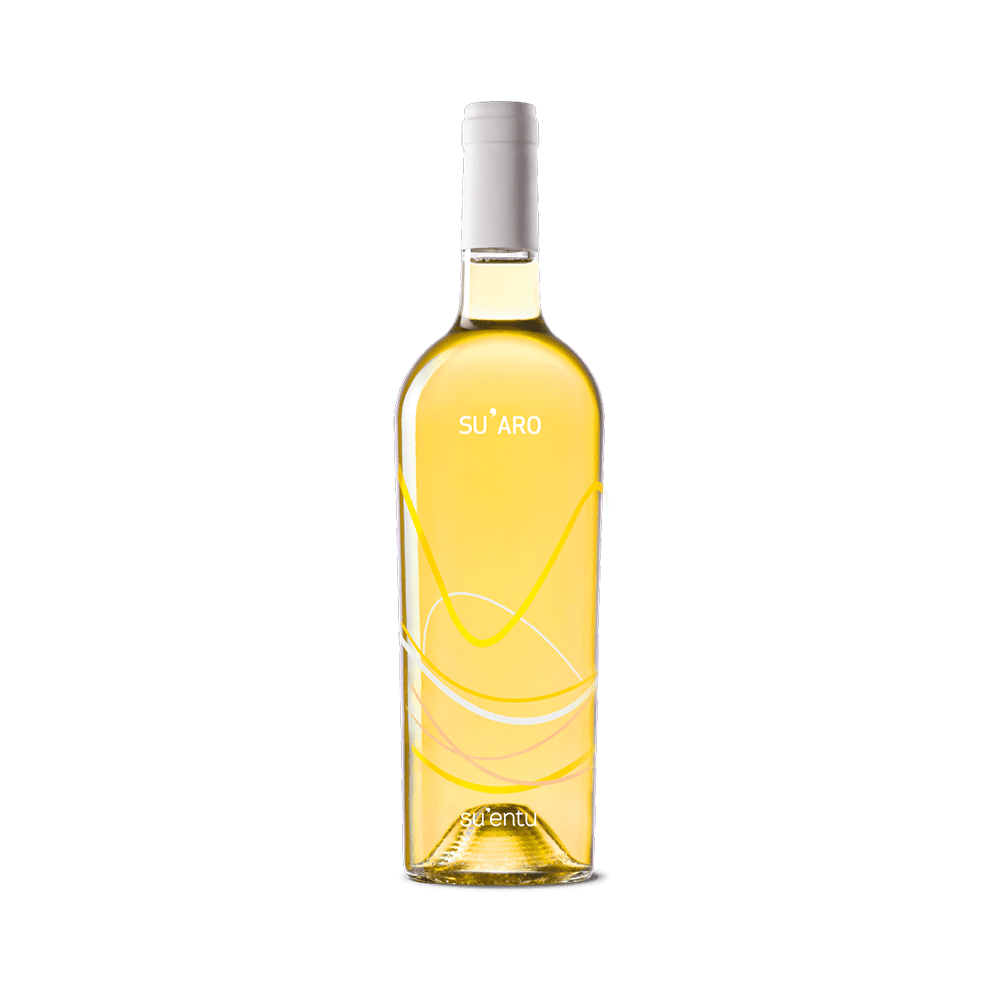
Today’s tasting note is dedicated to Su’Aro, a fresh yet aromatic white wine obtained through the careful blending of three different grape varieties (Muscat Blanc à Petits Grains, Nasco and Chardonnay), produced by the innovative Cantina Su’Entu from Sanluri, in the Marmilla region of Sardinia. Su’Aro is one of the estate’s most representative wines and a very successful example of how blending indigenous and international varieties can result in distinctive and attractive wines: modern, approachable, and fully capable of expressing the potential of the Marmilla terroir in an innovative way.
Cantina Su’Entu cultivates around 40 hectares of vineyards in Marmilla — a landscape constantly shaped by wind, an element that ensures ventilation, vineyard health, and a distinctive saline imprint on the grapes. The marked diurnal temperature shifts of the area further support slow and balanced ripening. To preserve freshness and aromatic precision, harvest for the estate’s top selections takes place entirely by hand and during the night.
Vineyard and Winemaking
Su’Aro is produced from a blend of white grape varieties: a small percentage of Muscat Blanc à Petits Grains (locally known as Moscato Bianco), together with Nasco (an indigenous variety) and Chardonnay (the most popular white grape variety in the world).
The vineyards are located on hills between Sanluri and Lunamatrona, with north-west exposure, at around 200 metres above sea level, on sandy-loam soils. Vines are trained using the Guyot system, with a planting density of approximately 4,500 vines per hectare and yields kept below 80 quintals per hectare. Harvest usually takes place during the second half of August and is carried out during the night in order to preserve freshness and aromatic integrity.
Before pressing, the grapes are refrigerated and then subjected to a short skin maceration (24–48 hours), designed to maximise the extraction of varietal aromas, particularly from the aromatic grapes. Only the free-run juice is used. After cold static clarification, fermentation takes place in stainless steel tanks at controlled temperatures (around 13 °C), favouring the development of fruity esters and preserving aromatic brightness.
Following fermentation, the wine matures for around four months in stainless steel on its fine lees, with regular bâtonnage, enhancing texture, aromatic complexity and finesse.
Tasting Profile
- Appearance: Bright pale lemon.
- Nose: High intensity of aromas, with a remarkably expressive and inviting bouquet. Tropical notes of pineapple, melon and banana — typical of warm-climate Chardonnay — emerge first, followed by white peach, ripe apple and gooseberry. Moscato contributes delicate grapey and floral notes, while Nasco brings its characteristic slightly musky nuance. Additional aromas of mint, fennel, brioche, cream and dried apricot add further complexity and depth.
- Palate: Dry, with medium(+) acidity and 13% alcohol, offering excellent balance. The wine is medium(+) bodied, with a soft, rounded texture that remains remarkably fresh and vibrant. The acidity and the delicate bitter edge on the finish — likely deriving from Nasco — help maintain tension and elegance. The palate echoes the aromatic profile perceived on the nose, complemented by a subtle saline touch.
- The finish is medium(+), persistent and harmonious, with good structure and precision..
Final Thoughts
Su’Aro is a highly approachable yet remarkably well-crafted wine — it is easy to understand why it has become one of the estate’s flagship labels. It combines an intensely aromatic profile, centred around tropical fruit and fresh herbs, with a rounded yet refreshing palate that makes it particularly enjoyable as an aperitif. It is the kind of wine that disappears from the glass almost too quickly, thanks to its smoothness and drinkability. Its moderate alcohol level further contributes to its easy-going character.
At the same time, its aromatic intensity and textural richness make it an excellent companion for food. In particular, it pairs beautifully with Asian cuisine — from California rolls and sashimi to Thai dishes such as Pad Thai or Pad See Ew, and even mildly spiced Indian curries. The choice to blend three very different grape varieties is undoubtedly bold, but it proves highly successful in this case, resulting in a wine that is both terroir-driven and stylistically distinctive when compared to the increasingly dominant Vermentino-based whites of Sardinia. Given its fruit-forward and aromatic profile, Su’Aro is best enjoyed young, when its freshness and exuberance are at their peak. There is no need to reserve too much cellar space for this one — just make sure to serve it well chilled, ideally around 6-8 °C, and enjoy its vibrant Mediterranean character.


Leave a Reply