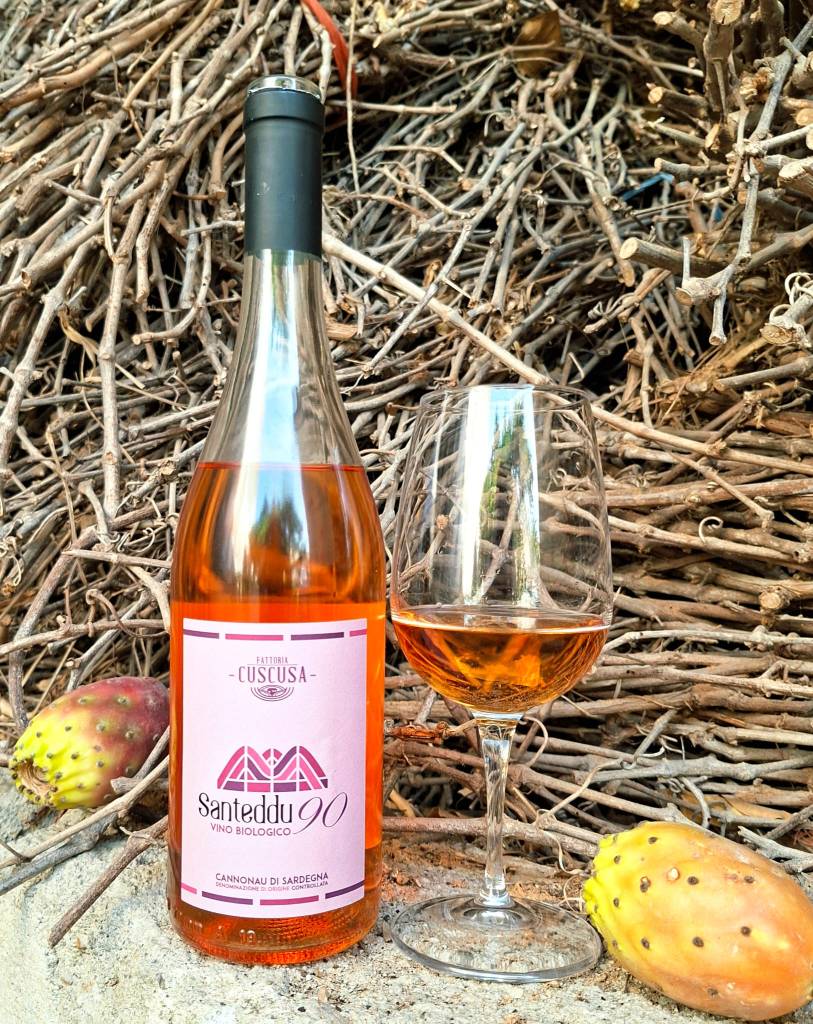
During the peak of the summer season, nothing is more appropriate than a refreshing and crunchy rosé. Today’s tasting note is therefore dedicated to Santeddu 90, an organic rosé produced by Fattoria Cuscusa, a family estate located in Gonnostramatza, a village in the historic Marmilla region of south-central Sardinia.
Santeddu 90 is yet another wine—like Gran Rosé, which I previously reviewed—that demonstrates the great potential of Cannonau (Sardinia’s name for Grenache) to produce high-quality rosé wines.
Rosé and organic wines are growing in popularity around the world, and Sardinia is no exception. An increasing number of producers are experimenting with different styles of rosé and organic viticulture, with some remarkable results.
Santeddu 90 fits perfectly into this dynamic. It is an approachable rosé, with a relatively moderate alcohol level of 12.5%, remarkable freshness and a fruit-forward character.
Fattoria Cuscusa is a multigenerational family estate based in Gonnostramatza. The estate extends over approximately 190 hectares, although only 2.5 hectares are dedicated to viticulture, planted with Cannonau and Vermentino. The entire estate is certified organic.
While the vast majority of the family’s extensive organic property is devoted to livestock grazing and the cultivation of animal feed such as forage, clover and corn, the family deliberately keeps its vineyard small and focused on quality. Annual production is approximately 15,000–20,000 bottles.
Besides Santeddu 90, the estate produces one red and two white wines. Its winemaking philosophy focuses on clean fruit, minimal intervention, unfiltered wines and reduced use of added sulphites, with approximately 40% less added sulphites than standard commercial wines.
Vineyard and Winemaking
Santeddu 90 is produced from Cannonau grapes grown in the countryside around Gonnostramatza, in the Marmilla region. The vines grow in clay and basalt soils, in an area located in front of an extinct volcano and close to one of Europe’s oldest obsidian mines.
This distinctive geological environment contributes to the wine’s mineral and saline character, while the warm Mediterranean climate allows the grapes to achieve good aromatic concentration while retaining the freshness required for a successful rosé.
Cannonau/Grenache is one of the classic varieties used for rosé production in both Spain and France. Santeddu 90 shows that Sardinia can also produce distinctive and high-quality rosés from the same grape.
The family harvests the grapes early, usually during the first ten days of September. Early harvesting helps preserve a crisp level of acidity, which is particularly important for producing a fresh and vibrant rosé.
The grapes are hand harvested into crates and immediately cooled to approximately 5°C for 72 hours before vinification. The winemaking is preceded by a 6–8-hour cold maceration, allowing the wine to extract delicate colour and fine berry aromas without extracting excessive tannins. The grapes are vinified according to the requirements applicable to organic wine production.
Once alcoholic fermentation is complete, the wine remains in contact with its fine lees (fecce nobili), contributing to a smoother texture and additional complexity. Santeddu 90 then matures in stainless-steel tanks for five to six months, followed by approximately one month of bottle ageing before release.
Tasting Profile
- Appearance: Bright and pale pink-orange.
- Nose: The wine has medium aromatic intensity, with a fruit-forward bouquet of redcurrant, raspberry, wild strawberry, pomegranate, orange, dried orange peel and prickly pear. These fruity aromas are complemented by an interesting earthy note reminiscent of crushed stone, together with herbal and balsamic notes of eucalyptus, mint, myrtle and rosemary.
- Palate: The wine is dry, with medium(+) acidity and 12.5% alcohol, resulting in a soft and approachable balance while retaining considerable freshness. The tannins are low and fine-grained, yet delicately persistent, providing a subtle structural backbone. The wine is medium(+) bodied, with a refreshing texture that also has an almost oily quality. It is easy-going, but not simplistic, with its mineral character providing additional definition and elegance. The flavours broadly mirror those found on the nose, with a distinctive yet delicate saline note that further enhances the wine’s freshness and vibrancy.
- Finish: The finish is medium(+), with good persistence. Lingering acidity helps extend the finish and works particularly well with the wine’s almost oily texture, while the delicate mineral and saline notes leave a refreshing final impression..
Final Thoughts
Santeddu 90 is a fruity and refreshing rosé that perfectly reflects the current interest in lighter, vibrant wines while retaining a distinct Sardinian identity. Its overall style is broadly consistent with the Cannonau- and Grenache-based rosés that are now common around the world. Yet Santeddu 90 offers more depth and structure than many of the lighter, Provençal-style rosés that dominate the market today.
It is rounder and more layered, with an aromatic profile that moves from the familiar red berry fruit of Grenache towards less obvious—but particularly intriguing—herbal and balsamic notes. The mineral and saline character complements the almost oily texture, while the crisp red fruit keeps the wine fresh and approachable.
What makes Santeddu 90 particularly interesting, however, is its ability to combine drinkability with personality. It is an easy wine to enjoy, but there is enough structure and aromatic complexity to make it worth paying attention to.
As a typical rosé, this is not a wine I would normally recommend for extended ageing. Yet the bottle I tasted was already five years old, and it still retained plenty of freshness and fruit character, which challenges that assumption to some extent.
This suggests that Santeddu 90 can certainly withstand at least five years of bottle ageing, during which it can retain its freshness while developing additional spicy and savoury nuances. Nevertheless, I would still be curious to taste a younger bottle to experience the wine at its most vibrant and fruit-driven stage.
This is a classic apéritif wine, best served fresh at around 6–8 °C, much like a white wine. Just imagine putting the bottle in a large ice bucket on a sunny terrace—whether in London, Cagliari or Hong Kong—and enjoying it with friends. Its moderate alcohol and refreshing character make it particularly easy to drink without becoming tiring.
At the same time, Santeddu 90 has enough structure and concentration to work beautifully with food. I would particularly recommend it with culurgiones, the traditional Sardinian dumplings whose mint-infused filling would echo the wine’s own herbal character.
It could also pair very well with richer vegetarian dishes such as melanzane alla parmigiana, where the wine’s acidity and freshness would cut through the richness of the dish. Another interesting option would be fish couscous, where the combination of fruit, freshness and salinity could complement both the seafood and the spices. Ultimately, Santeddu 90 is a compelling example of how Cannonau can move beyond powerful red wines and produce rosés with freshness, structure and a distinctive Mediterranean personality. It is approachable enough for a sunny afternoon, but sufficiently complex to reward a closer look—and perhaps another glass.


Leave a Reply