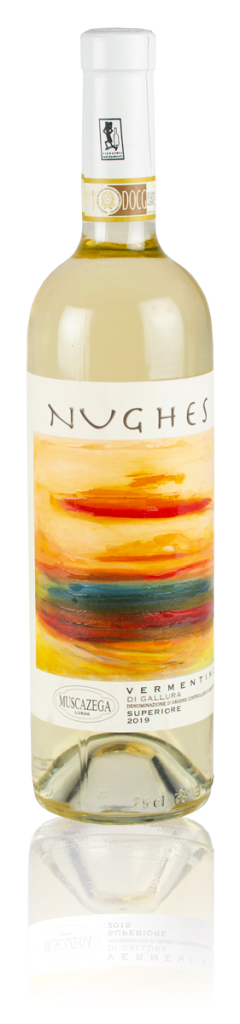
Today’s tasting note is dedicated to Nughes, a varietal white Vermentino di Gallura produced by Tenuta Muscazega in Luras, in the interior of Gallura. Nughes is the estate’s only white wine and is a particularly interesting and somewhat unconventional interpretation of Vermentino di Gallura, where minerality and herbal notes are more prominent than in many other examples of the appellation.
Nughes is a Vermentino di Gallura Superiore, meaning that it is subject to stricter production requirements, including lower permitted yields in the vineyard compared with standard Vermentino di Gallura. Established in 2006, Tenuta Muscazega produces most of its wines in the countryside around Luras, in north-western Sardinia. The estate extends over approximately 40 hectares, at around 500 metres above sea level, across the territories of Luras, Nuchis and Tempio Pausania. The winery’s focus is primarily on red wines, particularly those based on Nebbiolo, while Vermentino represents the other side of the estate’s identity.
Vineyard and Winemaking
Nughes is produced from a careful selection of Vermentino grapes, which are manually harvested and handled delicately in the cellar.
The grapes undergo soft pressing with separation of the stems, followed by approximately 16 hours of skin contact at controlled temperature. The must is then clarified through static settling and fermented with selected yeasts in stainless-steel tanks, preserving the freshness and aromatic character of the variety.
The wine subsequently remains in stainless-steel tanks before undergoing four to six months of bottle ageing, allowing it to develop greater balance between freshness and aromatic complexity. Production is limited to approximately 4,000 bottles per year.
Tasting Profile
- Appearance: Pale lemon.
- Nose: The wine has medium(+) aromatic intensity, with an intriguing and layered bouquet that is surprisingly restrained on the fruit side. Aromas of orange blossom and Scotch broom, both typical markers of Vermentino, are accompanied by green and yellow apple, roasted orange, lemon confit, yellow peach and apricot. There are also distinctive notes of Marcona almond, another characteristic Vermentino aroma, alongside yeast, hay and wet stones. Delicate herbal notes of thyme and rosemary become increasingly evident with time in the glass and are among the wine’s most distinctive features.
- Palate: The wine is dry, with medium(+) acidity and 13.5% alcohol, providing a good balance between freshness and substance. It is medium(+) bodied, with a relatively round texture that is nevertheless balanced by considerable elegance and vibrancy. The wine’s minerality comes through particularly clearly on the palate, giving it tension and definition. The flavours broadly mirror those found on the nose, with the addition of a distinctive yet delicate saline note and subtle flavours of white blossom.
- Finish: The finish is medium(+), with the characteristic bitter note often found in Vermentino lingering on the palate and adding further complexity. The combination of bitterness, salinity and minerality leaves a particularly refreshing final impression.
Final Thoughts
Nughes offers a different reading of Vermentino di Gallura. Many of the variety’s typical characteristics are clearly present: the distinctive minerality, the saline character, the characteristic bitter finish and familiar aromas such as orange blossom and almond. Yet Nughes departs from the more overtly fruity style often associated with Vermentino di Gallura.
Instead, its aromatic profile places considerably more emphasis on herbal, mineral and savoury notes, with hay, thyme, rosemary and yeast complementing the more traditional citrus, blossom and almond aromas. The result is a wine with a somewhat more restrained and contemplative personality.
Some of its secondary and savoury aromas may even evoke, at least stylistically, the aromatic vocabulary of Jerez or the Jura, particularly when the wine has had some time to open in the glass. This should not be taken as suggesting that Nughes is an oxidative wine—it is not—but rather that its combination of hay, yeast, salinity and restrained fruit takes Vermentino into less familiar territory.
For this reason, Nughes may not be the wine I would recommend as a first introduction to Vermentino di Gallura. But it is precisely this difference that makes it so interesting. It demonstrates the versatility of the variety and shows that Vermentino can produce wines that are not simply about fresh fruit and easy-drinking Mediterranean charm.
It also offers an additional layer of complexity that makes it particularly interesting at the table. Its minerality, salinity and structure give it considerably more gastronomic potential than its relatively approachable body might initially suggest.
While Nughes can certainly be enjoyed young, I think it could benefit from some bottle ageing, perhaps around five years, allowing its secondary and savoury aromas to develop further. Given its already distinctive aromatic profile and its good level of acidity, I would expect ageing to add complexity rather than simply diminish its freshness.


Leave a Reply